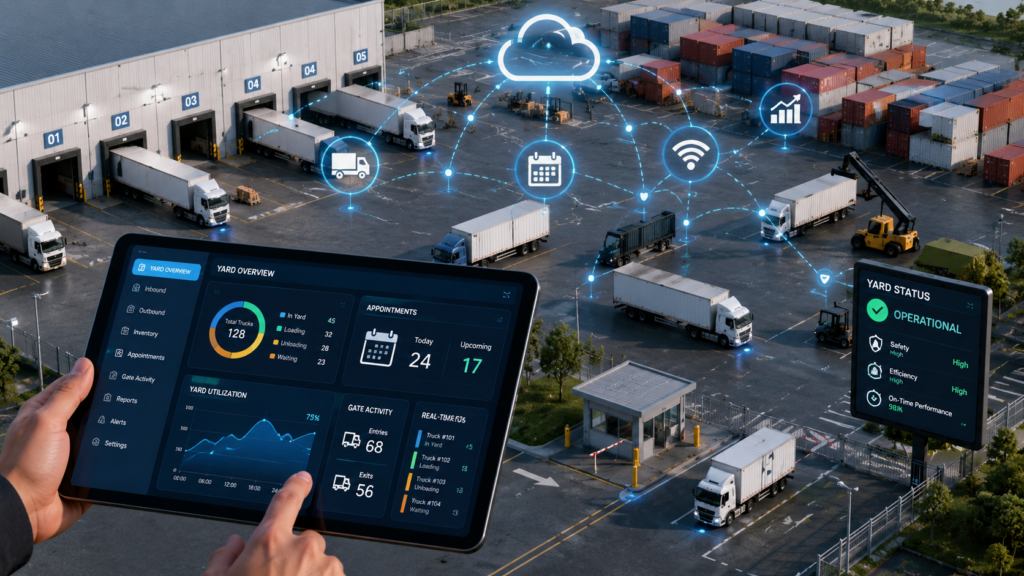
Yard Management System Benefits
Yard Management System Benefits: How Digitizing Your Yard Drives ROI in 2026 Managing a busy yard manually can quickly become complicated. Trucks arrive at different times, drivers wait for instructions, trailers need to be located, inventory moves between different areas, and yard teams need to coordinate with warehouse and transportation operations. As supply chains become […]
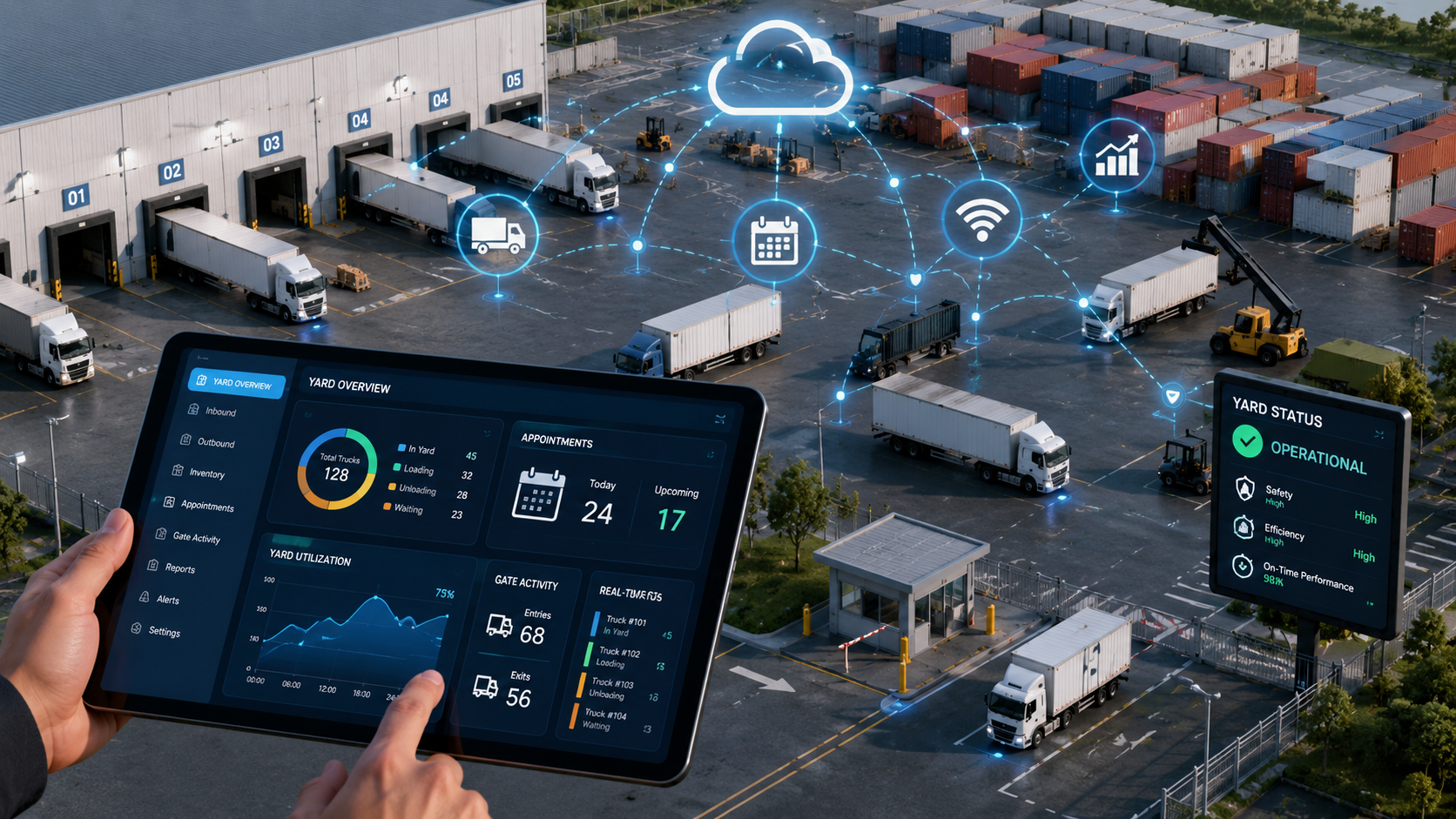
Yard Management System Benefits: How Digitizing Your Yard Drives ROI in 2026
Managing a busy yard manually can quickly become complicated. Trucks arrive at different times, drivers wait for instructions, trailers need to be located, inventory moves between different areas, and yard teams need to coordinate with warehouse and transportation operations.
As supply chains become more connected and customer expectations continue to increase, businesses are looking for smarter ways to manage these operations.
This is where a Yard Management System (YMS) can make a significant difference.
A modern YMS helps businesses digitize yard operations, improve visibility, reduce unnecessary delays, and optimize the movement of trucks, trailers, containers, and inventory within the yard.
More importantly, it can deliver measurable financial benefits.
In this article, we’ll explore the key benefits of a Yard Management System, how it improves operational efficiency, and why digitizing your yard can generate strong ROI in 2026.
What Is a Yard Management System?
A Yard Management System is a software solution designed to manage and optimize activities taking place within a warehouse, distribution center, manufacturing facility, logistics hub, or transportation yard.
A YMS can help businesses manage:
- Truck arrivals and departures
- Gate operations
- Trailer and container tracking
- Dock scheduling
- Yard inventory
- Driver check-in and check-out
- Vehicle movement
- Dock assignments
- Yard capacity
- Shipment visibility
- Real-time alerts
- Yard worker tasks
Instead of relying on spreadsheets, phone calls, paperwork, and manual communication, businesses can centralize yard operations through a digital platform.
Why Should Businesses Digitize Yard Operations?
The yard is often an overlooked part of the supply chain.
A warehouse may have sophisticated warehouse management software, while transportation teams may use transportation management systems. However, the area connecting these operations—the yard—can still depend heavily on manual processes.
This can create problems such as:
- Long truck waiting times
- Poor yard visibility
- Misplaced trailers
- Dock congestion
- Manual data entry
- Communication gaps
- Unplanned vehicle movements
- Driver delays
- Increased labor costs
- Poor utilization of yard space
Digitizing yard operations can help eliminate many of these inefficiencies.
Top Benefits of a Yard Management System in 2026
1. Real-Time Yard Visibility
One of the biggest benefits of a YMS is real-time visibility.
Instead of asking employees where a trailer or truck is located, teams can access the information directly through the system.
A modern YMS can provide visibility into:
- Vehicle location
- Trailer status
- Dock status
- Shipment status
- Yard capacity
- Arrival times
- Departure times
- Loading and unloading activities
This allows managers to make faster and better decisions.
2. Reduced Truck Waiting Time
Truck detention and waiting time can become a major operational expense.
When trucks arrive without proper scheduling or coordination, drivers may spend significant time waiting for:
- Gate clearance
- Dock availability
- Loading
- Unloading
- Yard assignments
- Documentation
A YMS can automate scheduling and coordinate yard activities to reduce unnecessary waiting.
Less waiting means:
Faster truck turnaround → Better fleet utilization → Lower operating costs
3. Better Dock Management
Dock congestion can negatively affect both warehouse and transportation operations.
A Yard Management System can help assign docks based on:
- Shipment priority
- Vehicle type
- Appointment time
- Product requirements
- Dock availability
- Loading or unloading requirements
This improves dock utilization and helps prevent bottlenecks.
4. Improved Gate Management
The gate is often the first and last point of interaction for trucks entering a facility.
Traditional gate processes may involve:
- Paperwork
- Manual verification
- Phone calls
- Data entry
- Security checks
A digital YMS can automate many of these processes.
Features may include:
- Digital check-in
- Driver verification
- Appointment validation
- Automated gate passes
- Vehicle identification
- Digital documentation
- Check-out tracking
This can significantly reduce gate processing time.
5. Better Trailer and Container Tracking
Finding the right trailer or container can be difficult when yard operations are managed manually.
A YMS provides a centralized view of yard assets and their current status.
Teams can quickly determine:
- Where a trailer is located
- Whether it is loaded or empty
- Which dock it is assigned to
- When it arrived
- How long it has been in the yard
- Whether it is ready for departure
This reduces the time employees spend searching for assets.
6. Increased Labor Productivity
Manual yard management requires employees to spend time on repetitive activities.
For example:
- Updating spreadsheets
- Calling drivers
- Checking vehicle locations
- Assigning parking positions
- Tracking trailer movements
- Communicating dock changes
A YMS can automate many of these tasks.
Employees can then spend more time on activities that require human decision-making.
7. Reduced Detention and Demurrage Costs
Unexpected delays can lead to additional transportation costs.
For certain operations, prolonged container or trailer dwell time may result in detention, demurrage, or other accessorial charges.
By improving visibility and reducing delays, a YMS can help businesses minimize these unnecessary costs.
This can be one of the most measurable financial benefits of yard digitization.
8. Better Yard Space Utilization
Yard space is limited and expensive.
Poor organization can result in:
- Empty spaces
- Congested areas
- Inefficient trailer placement
- Unnecessary vehicle movements
- Difficulty locating assets
A YMS can help optimize yard capacity by providing better visibility into available and occupied spaces.
Some advanced systems can also recommend optimal parking or staging locations.
9. Improved Communication
Yard operations involve multiple stakeholders.
These may include:
- Drivers
- Yard operators
- Warehouse teams
- Security teams
- Transportation managers
- Dock workers
- Suppliers
- Carriers
A centralized digital system helps ensure everyone works with the same information.
Instead of relying on multiple phone calls or messages, teams can access updated information from one platform.
10. Better Data and Analytics
One of the biggest advantages of digitization is access to operational data.
A YMS can help track metrics such as:
- Average truck dwell time
- Gate processing time
- Dock utilization
- Trailer dwell time
- Yard capacity
- Truck turnaround time
- Appointment adherence
- Yard movements
- Labor productivity
Managers can use these insights to identify bottlenecks and continuously improve operations.
How Does a Yard Management System Generate ROI?
The ROI of a YMS comes from reducing operational costs and improving asset utilization.
The financial impact can come from several areas.
Labor Savings
Automation reduces repetitive manual tasks.
Reduced Truck Waiting
Faster turnaround improves transportation efficiency.
Lower Detention Costs
Better coordination can reduce avoidable delays.
Improved Asset Utilization
Better visibility helps companies use trailers and equipment more effectively.
Increased Throughput
More efficient yard operations allow facilities to process more vehicles without necessarily expanding physical infrastructure.
Better Space Utilization
Optimized yard layouts can increase effective capacity.
A Simple Yard Management ROI Example
Consider a distribution facility that handles 100 trucks per day.
Suppose inefficient yard operations result in an average of 30 minutes of unnecessary waiting per truck.
That represents:
100 trucks × 30 minutes = 3,000 minutes
That’s approximately:
50 hours of waiting every day.
Even a small reduction in waiting time can create significant savings when multiplied across hundreds or thousands of truck movements every month.
A YMS can help reduce these delays through better appointment scheduling, real-time visibility, automated gate processes, and improved dock coordination.
The exact ROI will depend on the facility’s volume, labor costs, detention charges, operational processes, and YMS implementation cost.
Important Features of a Modern Yard Management System
When evaluating a YMS in 2026, businesses should consider features such as:
Real-Time Yard Visibility
Track vehicles, trailers, containers, and yard activities.
Appointment Scheduling
Manage incoming and outgoing vehicle appointments.
Digital Gate Management
Automate check-in and check-out processes.
Dock Management
Improve dock assignment and scheduling.
Trailer Tracking
Monitor trailer locations and status.
Yard Mapping
Visualize available and occupied yard spaces.
Automated Notifications
Send alerts to drivers, operators, and managers.
Analytics Dashboard
Monitor KPIs and operational performance.
Mobile Access
Allow yard teams to access information from mobile devices.
System Integrations
Connect the YMS with other business systems.
YMS Integration With Other Supply Chain Systems
A Yard Management System becomes even more valuable when integrated with existing technology.
Common integrations include:
- Warehouse Management System (WMS)
- Transportation Management System (TMS)
- Enterprise Resource Planning (ERP)
- Enterprise systems
- Transportation carriers
- Barcode systems
- RFID
- IoT sensors
- GPS tracking
- Access control systems
Integration creates a more connected supply chain where information can move between systems automatically.
Yard Management System and IoT
IoT technology can make yard management even smarter.
Connected devices and sensors can provide real-time information about:
- Trailer locations
- Vehicle movements
- Equipment status
- Yard occupancy
- Temperature
- Asset conditions
This data can be used by the YMS to improve visibility and automate decisions.
The Role of AI in Yard Management
Artificial intelligence is becoming increasingly relevant to logistics operations.
AI-powered YMS solutions can potentially help businesses:
- Predict yard congestion
- Recommend optimal dock assignments
- Forecast truck arrivals
- Optimize trailer positioning
- Identify operational bottlenecks
- Predict delays
- Improve resource allocation
Instead of simply showing what is happening, future systems will increasingly help businesses determine what should happen next.
Challenges of Implementing a YMS
Although a YMS can provide significant benefits, implementation requires planning.
Common challenges include:
Integration Complexity
Connecting the YMS with existing WMS, TMS, ERP, and other systems can require technical planning.
Employee Adoption
Employees need proper training and support during the transition.
Data Quality
Accurate master data and operational information are important for reliable system performance.
Process Changes
Digitization may require businesses to redesign existing yard processes.
Initial Investment
Software implementation, integration, hardware, training, and customization can create an upfront cost.
However, these costs should be evaluated against the long-term operational savings and productivity improvements.
How to Successfully Implement a Yard Management System
A successful implementation should start with understanding current operations.
Step 1: Analyze Existing Processes
Identify current bottlenecks and manual processes.
Step 2: Define Business Goals
Determine what you want to improve.
For example:
- Reduce truck waiting time
- Reduce detention costs
- Improve yard visibility
- Increase dock utilization
Step 3: Select the Right YMS
Choose a platform that supports your operational requirements and future growth.
Step 4: Plan Integrations
Identify the systems that need to exchange data with the YMS.
Step 5: Train Employees
Provide training to drivers, yard operators, managers, and other stakeholders.
Step 6: Measure Results
Track KPIs before and after implementation to determine the actual ROI.
Key KPIs to Measure YMS ROI
Businesses should measure performance before and after implementing a YMS.
Important KPIs include:
- Truck turnaround time
- Average dwell time
- Gate processing time
- Dock utilization
- Trailer dwell time
- Detention costs
- Labor hours
- Yard capacity utilization
- Appointment adherence
- Number of manual transactions
These metrics provide a clear picture of whether the technology is delivering the expected business value.
Is a Yard Management System Worth the Investment?
For businesses managing high-volume yards, warehouses, distribution centers, manufacturing facilities, and logistics operations, a YMS can provide significant operational value.
The biggest benefits come from:
Visibility + Automation + Better Coordination + Data-Driven Decisions
Instead of treating the yard as an isolated part of the supply chain, businesses can make it a connected and intelligent operation.
The result can be faster truck turnaround, better asset utilization, reduced operational costs, and improved customer service.
Final Thoughts
Yard operations play an important role in overall supply chain performance.
When yards depend on manual processes, spreadsheets, phone calls, and disconnected systems, small inefficiencies can quickly become expensive.
A modern Yard Management System helps businesses digitize these operations, improve real-time visibility, automate workflows, and make better decisions.
In 2026, the question is no longer simply whether businesses should digitize their yards. The bigger question is how quickly they can turn yard data into measurable operational and financial improvements.
For organizations handling significant truck, trailer, container, or warehouse activity, investing in the right YMS can become an important step toward building a more efficient, scalable, and technology-driven supply chain.
Frequently Asked Questions
What is a Yard Management System?
A Yard Management System is software that helps businesses manage and optimize vehicles, trailers, containers, docks, gates, inventory, and other activities within a logistics or warehouse yard.
What are the main benefits of a YMS?
The main benefits include improved yard visibility, reduced truck waiting time, better dock utilization, lower detention costs, improved labor productivity, and better asset utilization.
Can a YMS reduce logistics costs?
Yes. By reducing waiting time, improving scheduling, optimizing yard space, and reducing manual processes, a YMS can help businesses reduce several operational costs.
Can a YMS integrate with WMS and TMS?
Yes. Modern YMS platforms can integrate with Warehouse Management Systems, Transportation Management Systems, ERP platforms, IoT devices, GPS systems, and other supply chain technologies.
How does AI improve yard management?
AI can help predict congestion, optimize vehicle and dock assignments, forecast arrivals, identify bottlenecks, and improve resource planning.
Is a YMS suitable for small businesses?
It depends on operational complexity and yard volume. Businesses with frequent truck movements, multiple docks, trailers, or significant yard congestion may benefit from YMS technology even if they are not large enterprises.
"Tech tools are the threads, but the fabric is woven through the way we understand each other, grow, and heal together."

Read Next

SaaS Development Cost in 2026
SaaS Development Cost in 2026: A Complete Budgeting Guide from MVP to Enterprise Building a…

How Much Does It Cost to Build a Chatbot in 2026?
How much does it cost to build a chatbot? This is one of the first…