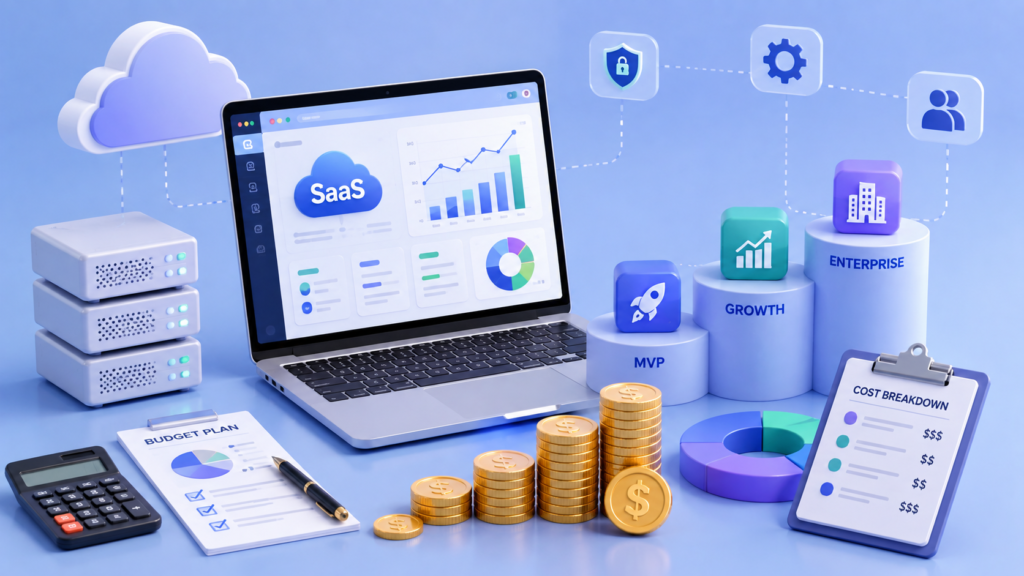
SaaS Development Cost in 2026
SaaS Development Cost in 2026: A Complete Budgeting Guide from MVP to Enterprise Building a SaaS product can be an exciting business opportunity, but one of the first questions founders and businesses ask is: How much does SaaS development cost in 2026? The answer depends heavily on the product’s complexity, number of users, features, integrations, […]
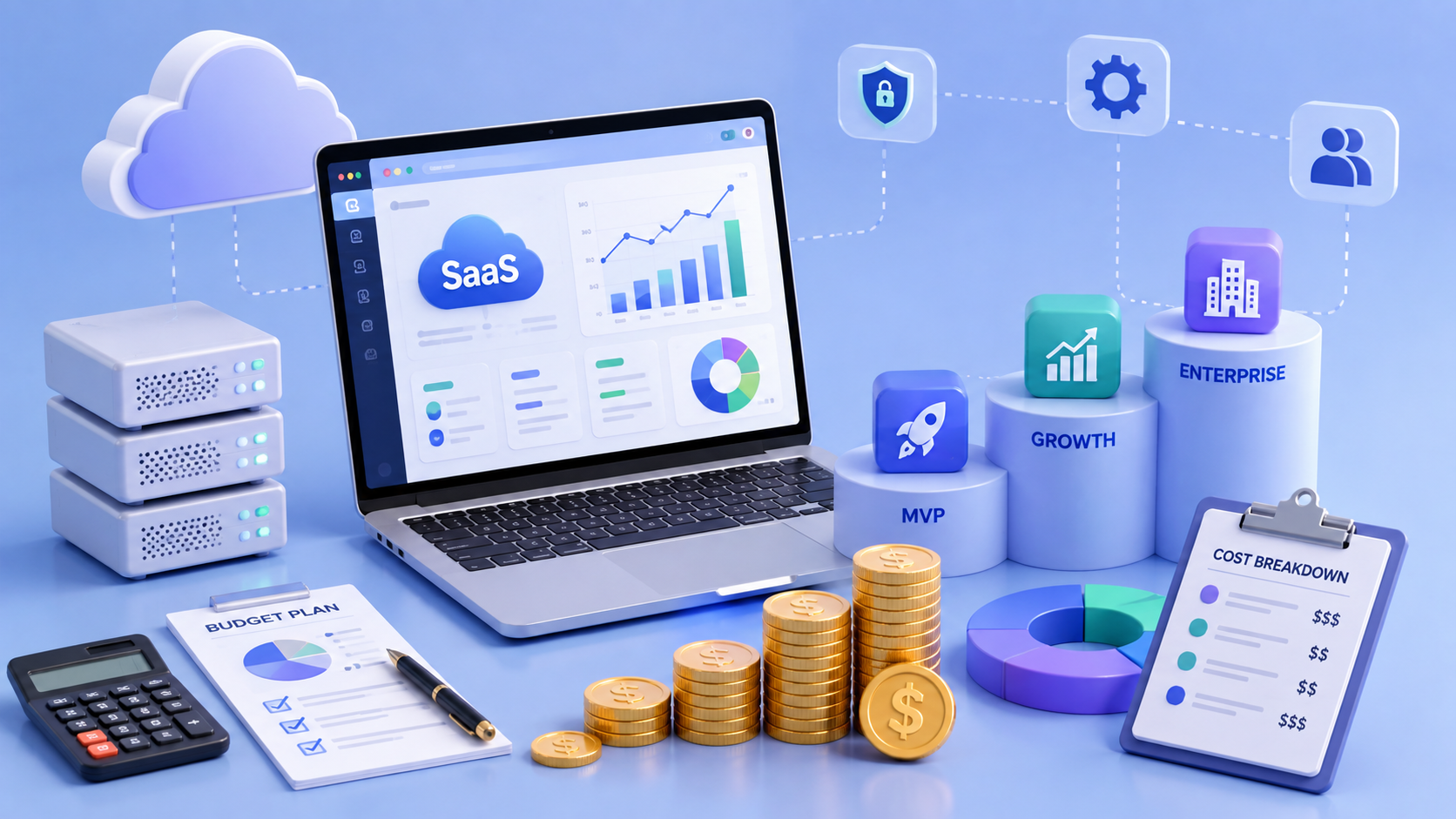
SaaS Development Cost in 2026: A Complete Budgeting Guide from MVP to Enterprise
Building a SaaS product can be an exciting business opportunity, but one of the first questions founders and businesses ask is: How much does SaaS development cost in 2026?
The answer depends heavily on the product’s complexity, number of users, features, integrations, technology stack, security requirements, and scalability goals.
A simple SaaS MVP may cost a few lakh rupees, while a production-ready enterprise SaaS platform can require several crores. Current 2026 estimates show wide variation because SaaS products range from small single-purpose applications to complex multi-tenant platforms with AI, advanced analytics, billing, and enterprise security.
In this guide, we’ll break down the SaaS development cost in 2026, including MVP development, feature costs, technology choices, team requirements, ongoing expenses, development timelines, and practical ways to control your budget.
How Much Does It Cost to Build a SaaS Product in 2026?
As a broad planning range, SaaS development can fall into these categories:
| SaaS Product Type | Estimated Development Cost | Typical Timeline |
|---|---|---|
| SaaS Prototype / Proof of Concept | ₹1.5 Lakh – ₹4 Lakh | 3–6 weeks |
| Basic SaaS MVP | ₹3 Lakh – ₹8 Lakh | 6–12 weeks |
| Standard Multi-Tenant SaaS | ₹8 Lakh – ₹20 Lakh | 3–6 months |
| Advanced SaaS Platform | ₹20 Lakh – ₹50 Lakh+ | 5–9 months |
| Enterprise SaaS | ₹50 Lakh – ₹1 Crore+ | 9–18+ months |
These figures are indicative rather than fixed quotations. Scope, architecture, integrations, team composition, security requirements, and product complexity can move the final budget substantially.
What Is SaaS?
SaaS stands for Software as a Service.
Instead of installing software locally, users access a SaaS product through the internet, generally using a web browser or mobile application.
Popular SaaS categories include:
- CRM platforms
- Project management tools
- Accounting software
- HR management systems
- Marketing platforms
- Communication tools
- Ecommerce software
- Healthcare platforms
- Logistics software
- AI-powered applications
- Business analytics platforms
Most SaaS businesses operate using a subscription model such as monthly or annual plans.
A typical SaaS architecture may include:
Frontend + Backend + Database + Authentication + Subscription Billing + APIs + Cloud Infrastructure + Admin Panel
Each of these components contributes to the overall development cost.
SaaS Development Cost by Product Complexity
1. SaaS Prototype or Proof of Concept
A prototype is designed to validate an idea before investing heavily in development.
It may include:
- Basic UI
- Core user flow
- Clickable prototype
- Limited functionality
- Basic technical demonstration
Estimated Cost
₹1.5 Lakh – ₹4 Lakh
Best For
- Testing an idea
- Investor demonstrations
- User feedback
- Validating product workflows
A prototype is not normally intended to serve thousands of real customers.
2. SaaS MVP Development
An MVP, or Minimum Viable Product, contains the essential features required to launch and validate a SaaS business.
Typical MVP functionality may include:
- User registration
- Login
- User profile
- Dashboard
- Core SaaS workflow
- Basic admin panel
- Subscription plans
- Payment integration
- Email notifications
Estimated Cost
₹3 Lakh – ₹8 Lakh
However, more sophisticated SaaS MVPs with multiple user roles, integrations, analytics, and multi-tenancy can cost considerably more. Recent 2026 India estimates place many properly scoped SaaS MVPs in ranges from roughly ₹1.5 lakh to ₹8 lakh depending on scope.
3. Standard Multi-Tenant SaaS
A multi-tenant SaaS allows multiple businesses or organizations to use the same application while keeping their data and permissions separated.
For example, a CRM SaaS may have:
Company A → Users → Data
Company B → Users → Data
Company C → Users → Data
This requires more sophisticated architecture than a basic single-user application.
Estimated Cost
₹8 Lakh – ₹20 Lakh
Features may include:
- Multi-tenancy
- Multiple user roles
- Subscription management
- Team management
- Advanced dashboards
- API integrations
- Notifications
- Analytics
- Admin controls
- Security features
4. Advanced SaaS Platform
An advanced SaaS product may include multiple modules and complex business workflows.
For example:
- CRM
- Billing
- Reporting
- Analytics
- Automation
- AI features
- Third-party integrations
- Advanced permissions
- Mobile applications
Estimated Cost
₹20 Lakh – ₹50 Lakh+
At this stage, architecture and scalability become increasingly important because the product needs to support more users, data, integrations, and business processes.
5. Enterprise SaaS
Enterprise SaaS platforms are built for large organizations with demanding security, scalability, integration, and compliance requirements.
They may include:
- Enterprise authentication
- Single Sign-On (SSO)
- Role-based access control
- Audit logs
- Advanced analytics
- AI modules
- Multiple APIs
- Enterprise integrations
- High availability
- Data encryption
- Advanced monitoring
- Custom workflows
- Compliance requirements
Estimated Cost
₹50 Lakh – ₹1 Crore+
Complex enterprise products can go significantly beyond this range depending on the requirements.
Major Factors That Affect SaaS Development Cost
The development cost isn’t determined by the number of pages alone.
Several technical and business factors affect the final budget.
1. Product Complexity
A simple appointment scheduling SaaS is significantly easier to build than an enterprise ERP platform.
Complexity increases when the product requires:
- Multiple workflows
- Advanced permissions
- Automation
- Real-time functionality
- AI
- Analytics
- Multiple integrations
- Complex business rules
2. Number of User Roles
A SaaS application may have different users such as:
- Super Admin
- Business Admin
- Manager
- Employee
- Customer
- Vendor
Each role may require different permissions and workflows.
The more complex the permission system, the more development and testing are required.
3. Multi-Tenant Architecture
Multi-tenancy is one of the most important architectural decisions for SaaS products.
The application needs to ensure that each organization’s data remains isolated and secure while allowing the platform to scale efficiently.
Multi-tenant architecture can increase both initial development complexity and testing requirements.
4. UI/UX Design
A professional SaaS product requires more than functional screens.
The design may include:
- User research
- Information architecture
- Wireframes
- Prototypes
- Design systems
- Responsive layouts
- Accessibility
- Usability testing
- Custom dashboards
Investing in UX early can help reduce usability problems and expensive redesigns later.
5. Backend Development
The backend handles the core business logic of the SaaS product.
It may manage:
- Users
- Authentication
- Permissions
- Database operations
- APIs
- Payments
- Notifications
- Business workflows
- Integrations
- Security
The complexity of the backend can have a major impact on development time and cost.
6. Third-Party Integrations
Integrations can significantly increase SaaS development costs.
Common integrations include:
- Stripe
- PayPal
- Razorpay
- Salesforce
- HubSpot
- Slack
- Google APIs
- Microsoft APIs
- Email services
- SMS providers
- Accounting systems
- ERP platforms
- AI APIs
Every integration requires development, authentication, testing, error handling, and ongoing maintenance.
7. AI Features
AI is becoming a major component of SaaS products in 2026.
AI functionality may include:
- AI chatbots
- AI content generation
- Document analysis
- Recommendation engines
- AI search
- Predictive analytics
- RAG-based knowledge assistants
- Automated workflows
Adding AI can increase both development and operational costs because businesses may need AI APIs, vector databases, additional infrastructure, evaluation systems, and monitoring.
8. Security Requirements
Security becomes especially important when a SaaS platform handles sensitive business or customer information.
Depending on the product, requirements may include:
- Encryption
- Secure authentication
- Role-based access
- API security
- Data isolation
- Audit logs
- Backup systems
- Monitoring
- Vulnerability testing
- Compliance requirements
Enterprise and regulated-industry SaaS products typically require more investment in security than basic applications.
SaaS Development Cost Breakdown
A SaaS development budget can generally be divided across several areas.
| Development Area | Typical Impact on Budget |
|---|---|
| Discovery & Planning | 5% – 10% |
| UI/UX Design | 10% – 15% |
| Frontend Development | 15% – 25% |
| Backend Development | 20% – 30% |
| Database & Architecture | 5% – 15% |
| Testing & QA | 10% – 15% |
| DevOps & Deployment | 5% – 10% |
| Integrations | Depends on Scope |
| Security & Compliance | Depends on Requirements |
These percentages are useful for budgeting, but an actual project should be estimated from the features and technical architecture rather than applying fixed percentages.
SaaS Development Timeline
The development timeline depends on the scope and team size.
Prototype
3–6 weeks
SaaS MVP
6–12 weeks
Multi-Tenant SaaS
3–6 months
Advanced SaaS
5–9 months
Enterprise SaaS
9–18+ months
A larger development team doesn’t always mean a proportionally faster project. Architecture, dependencies, testing, and product decisions can become bottlenecks.
Technology Stack for SaaS Development
The technology stack depends on the product’s requirements.
A typical modern SaaS stack may include:
Frontend
- React
- Next.js
- Vue.js
- Angular
Backend
- Node.js
- Python
- Java
- .NET
- PHP
Database
- PostgreSQL
- MySQL
- MongoDB
- Redis
Cloud
- AWS
- Microsoft Azure
- Google Cloud
DevOps
- Docker
- Kubernetes
- CI/CD
- Cloud monitoring
The best technology stack isn’t necessarily the newest one. It should be selected based on scalability, developer availability, performance, security, and long-term maintenance.
SaaS Development Cost: In-House vs Outsourcing
Businesses generally have three common options for building SaaS products.
In-House Development
You hire your own team.
Advantages
- Full control
- Long-term product knowledge
- Direct communication
Disadvantages
- Higher hiring costs
- Salaries and benefits
- Infrastructure expenses
- Recruitment time
- Team management
Freelancers
Freelancers can be useful for smaller projects or specific tasks.
Advantages
- Lower initial cost
- Flexible hiring
- Useful for specific expertise
Disadvantages
- Communication challenges
- Limited accountability
- Availability issues
- Difficult to manage large projects
Software Development Company
A professional development company can provide a complete team including:
- Business analysts
- UI/UX designers
- Developers
- QA engineers
- DevOps engineers
- Project managers
This approach can be useful for businesses that want to build and launch a complete SaaS product without creating an internal engineering team.
Hidden Costs of SaaS Development
Many businesses focus only on the initial development quote.
However, SaaS has ongoing costs after launch.
Cloud Hosting
You may need to pay for:
- Servers
- Databases
- Storage
- CDN
- Monitoring
- Backups
Third-Party Services
Recurring expenses can include:
- Payment gateways
- Email services
- SMS
- AI APIs
- Analytics
- Customer support tools
Maintenance
A production SaaS product needs regular:
- Bug fixes
- Security updates
- Performance improvements
- Dependency updates
- Feature enhancements
Customer Support
As the number of customers grows, you may also need dedicated support infrastructure and staff.
Recent 2026 SaaS cost guides emphasize that the real budget should account for both the initial build and ongoing operating costs rather than treating development as a one-time expense.
How to Reduce SaaS Development Costs
Reducing cost doesn’t necessarily mean choosing the cheapest development team.
The better strategy is to reduce unnecessary scope.
Start With an MVP
Build only the features required to validate your business model.
Avoid building features that users may never use.
Prioritize Features
Divide features into:
Must Have
Should Have
Could Have
Future
Build the “Must Have” features first.
Use Existing APIs
Instead of developing every service from scratch, use reliable third-party APIs where appropriate.
Choose the Right Architecture
Don’t over-engineer an early-stage product, but don’t make architectural decisions that will make future scaling unnecessarily difficult.
Invest in UX Early
A well-planned UX can reduce redesign and development rework.
Automate Testing and Deployment
CI/CD and automated testing can reduce repetitive work and make future releases safer.
How Much Should You Budget for the First Year?
The initial development cost is only part of the total investment.
For example, if your SaaS development costs ₹10 lakh, your first-year budget should also account for:
- Cloud infrastructure
- Domain and SSL
- Third-party APIs
- Payment processing
- Email/SMS services
- Monitoring
- Maintenance
- Security
- Customer support
- Marketing
This means your actual first-year SaaS investment can be significantly higher than the development quotation alone.
SaaS ROI: Is It Worth the Investment?
SaaS can be highly scalable because the same software platform can serve many customers.
Once the core platform is built, additional customers can often be onboarded without rebuilding the product from scratch.
However, profitability depends on factors such as:
- Customer acquisition cost
- Monthly recurring revenue
- Customer lifetime value
- Churn rate
- Infrastructure costs
- Support costs
- Development costs
A successful SaaS business therefore needs both a strong product and a sustainable business model.
Final Thoughts
The SaaS development cost in 2026 can range from a few lakh rupees for a focused MVP to ₹1 crore or more for a complex enterprise platform.
The biggest mistake businesses can make is trying to determine the cost based only on the number of screens or features.
A realistic SaaS budget should consider:
Product Scope + UX + Architecture + Development + Integrations + Security + Testing + Infrastructure + Maintenance
Start with a clear product strategy, define your MVP, prioritize the features that directly support your business goals, and choose an architecture that can evolve with your customer base.
The goal isn’t to build the cheapest SaaS product.
The goal is to build the right SaaS product at the right stage of your business.
Frequently Asked Questions
How much does it cost to build a SaaS product in 2026?
A SaaS product can cost approximately ₹3 lakh–₹8 lakh for a focused MVP, ₹8 lakh–₹20 lakh for a standard multi-tenant platform, and ₹50 lakh–₹1 crore+ for enterprise-level solutions. The actual cost depends on scope and technical requirements.
How much does a SaaS MVP cost in India?
A focused SaaS MVP can start around ₹3 lakh, while more feature-rich MVPs can reach ₹8 lakh or more. Multi-tenant architecture, multiple user roles, integrations, billing, and analytics can increase the budget significantly.
How long does it take to build a SaaS product?
A basic MVP can take around 6–12 weeks, while a production-ready multi-tenant SaaS product can take several months. Enterprise SaaS platforms may require 9–18 months or more.
What factors affect SaaS development cost?
The major factors include product complexity, number of user roles, multi-tenancy, UI/UX requirements, integrations, AI functionality, security, compliance, technology stack, testing, and scalability requirements.
Does SaaS development have ongoing costs?
Yes. SaaS products require ongoing spending on cloud hosting, APIs, maintenance, security, monitoring, support, and product improvements.
Is it better to build SaaS in-house or outsource development?
Both approaches can work. In-house teams provide greater long-term control, while outsourcing can provide access to a complete development team without the cost and time required to build an internal team.
Can AI reduce SaaS development costs?
AI-assisted development can improve developer productivity and speed up certain tasks, but it doesn’t eliminate the need for architecture, security, testing, product management, and experienced engineering. The build-vs-buy decision should consider total ownership cost, not just coding speed.
"Tech tools are the threads, but the fabric is woven through the way we understand each other, grow, and heal together."

Read Next
Yard Management System Benefits
Yard Management System Benefits: How Digitizing Your Yard Drives ROI in 2026 Managing a busy…

How Much Does It Cost to Build a Chatbot in 2026?
How much does it cost to build a chatbot? This is one of the first…